
 April 27, 2026
  10 Min
  No Comment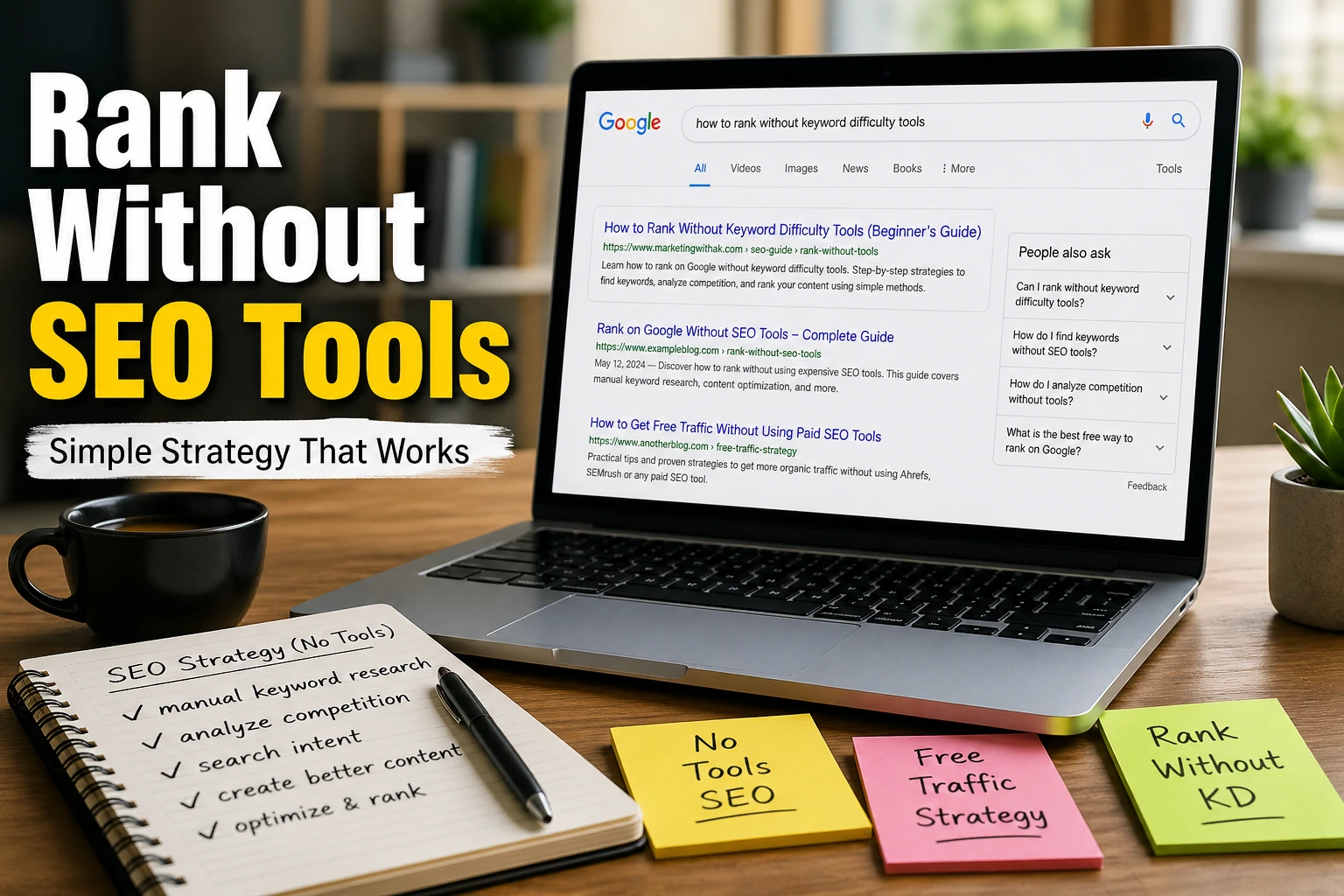
No Ahrefs? No SEMrush? Still want to rank on Google? You are not alone. Thousands of bloggers start with zero budget and still manage to build organic traffic over time. The good news is that you do not need expensive tools to rank. You just need the right strategy.
This guide will show you exactly how to find the right keywords, analyze competition, and create content that ranks, all without spending a single rupee on paid SEO tools. This is the practical, no-fluff approach that works for beginners and small blogs alike.
Can You Really Rank Without Keyword Difficulty Tools?
Why Most Bloggers Depend on SEO Tools
Most beginner bloggers think they need a KD (Keyword Difficulty) score to decide which keywords to target. Tools like Ahrefs, SEMrush, and Moz give you a number, and it feels like a safety net. If the score is low, you feel confident. If it is high, you skip the keyword entirely.
But here is the problem. That dependency can become a trap. Many bloggers with no budget give up before they even start because they cannot afford these tools. They assume SEO is only for those who can pay for subscriptions. That assumption is simply not true.
The Truth About Keyword Difficulty Metrics
Keyword difficulty scores are estimates. They are calculated based on backlink profiles, domain authority, and other data points that vary from tool to tool. Two different tools can give you two very different KD scores for the same keyword.
This means KD is a guideline, not a rule. Real ranking is not determined by a number on a dashboard. It is determined by how well your content matches what the user is searching for.
How Google Actually Ranks Content
Google ranks content based on a combination of factors. Understanding these helps you work smarter without relying on tool-based data.
- Relevance: Does your content match the search query?
- Intent Match: Does your content format match what users expect to find?
- Content Quality: Is it helpful, accurate, and well-structured?
- Topical Authority: Do you cover a subject in depth across multiple posts?
At MarketingWithAk, the focus is always on these real ranking factors instead of tool-based assumptions. That is what drives consistent organic growth for new blogs.
Understanding Search Intent (The Real Ranking Factor)
Types of Search Intent
Search intent is the reason behind a search query. Before you write a single word, you need to understand what the searcher actually wants. There are four main types:
- Informational: The user wants to learn something (e.g., how to do SEO without tools)
- Navigational: The user is looking for a specific website or brand
- Transactional: The user wants to buy or take action
- Commercial: The user is comparing options before making a decision
For most blog content, the intent is informational. Your job is to provide the clearest, most complete answer possible.
How to Identify Intent Without Tools
You do not need any tools to understand search intent. Just search your keyword on Google and observe the results. Look at what type of content appears. If you see mostly how-to guides and list posts, that tells you the user wants simple, practical information. If you see product pages, the intent is transactional.
The search engine results page (SERP) itself is your most powerful free research tool. Read the titles, check the formats, and note what kind of content dominates the top positions.
Matching Content with Intent
Once you know the intent, create content that matches it. If the top results are tutorials, write a tutorial. If they are comparison posts, write a comparison. Do not write a product review when the intent is informational. Google rewards content that satisfies what users are searching for.
Step-by-Step Method to Rank Without Keyword Difficulty Tools
Step 1: Find Keywords Using Free Methods
You do not need a paid tool to discover great keywords. Google itself gives you all the data you need for free.
- Google Autocomplete: Start typing your topic in the search bar and see what Google suggests. These are real searches people are making every day.
- People Also Ask (PAA): Scroll down to the PAA box in search results. These are questions real users are asking related to your topic.
- Related Searches: At the bottom of Google results, you will find a section called Related Searches. These are goldmines for low competition keyword ideas.
This is the foundation of manual keyword research. These suggestions come directly from Google’s data, which makes them extremely reliable for identifying what people are actually searching for.
Step 2: Analyze Competition Manually (No Tools Needed)
Once you have a keyword in mind, search for it on Google and study the first page results carefully. Here is what to look for:
- Domain Strength: Are you seeing big authority sites like Forbes or Wikipedia, or are small blogs ranking? If small blogs are on the first page, you have a chance.
- Content Quality: Read the top-ranking posts. Are they well-written, detailed, and helpful? Or are they outdated and thin?
- Content Depth: Does the top result actually answer the user’s question fully, or does it leave gaps?
This manual SERP analysis gives you a clear picture of the competition without any paid subscription. If the existing content is weak or outdated, that is your opportunity.
Step 3: Identify Weak Content Opportunities
Not every top-ranking page deserves to be there. Look for signs of weak content in your search results:
- Outdated information (posts from 3 to 5 years ago that have not been updated)
- Thin content (short posts that barely answer the question)
- Poor structure (no headings, no bullet points, hard to read)
- Missing subtopics (important questions left unanswered)
When you spot these weaknesses, you have found a content gap. This is where your low competition keyword identification happens naturally. If you can create a more complete, more useful post, Google is likely to reward you with a higher ranking.
Step 4: Create Better Content Than Competitors
This is where you actually win rankings. Writing better content does not mean writing longer content. It means writing more useful content. Here is how:
- Answer the full question, not just part of it
- Use clear headings to organize your content
- Add examples, steps, and practical tips
- Keep paragraphs short and scannable
- Include data, facts, or personal experience where relevant
Focus on solving the user problem completely. When someone reads your post, they should not need to go back to Google to find more information. That is the content optimization goal you should always aim for.
Step 5: Optimize Without Tools
On-page SEO does not require any tool. Once your content is written, apply these basics:
- Title Tag: Place your primary keyword near the beginning of the title
- Meta Description: Write a short, clear description that includes your keyword and tells users what they will find
- Headings (H1 to H3): Use your keyword and related phrases naturally in headings
- Keyword Placement: Include your keyword in the first 100 words, a few times in the body, and in the conclusion
- Image Alt Text: Describe your images using relevant keywords
These are simple but powerful on-page SEO techniques. They do not require tools to implement, and they make a real difference in how search engines understand your content.
Proven Strategies to Rank Without SEO Tools
Focus on Long-Tail Keywords
Long-tail keywords are phrases with three or more words. They have lower search volume but also much lower competition. Instead of targeting a broad term like SEO tips, go for something like how to do SEO without ahrefs or semrush for a new blog. These specific searches are easier to rank for and often convert better because the user has a very clear intent.
Build Topical Authority
Topical authority means becoming a go-to resource on a specific subject. If your blog covers one topic from many angles, Google starts to see it as an expert source. Write multiple related blog posts that cover different aspects of your main topic. Interlink them together so readers and search engines can navigate your content easily.
This is the exact strategy used at MarketingWithAk to grow new blogs from zero. By creating clusters of related content, you build authority without needing backlinks from big websites.
Use Internal Linking Smartly
Every time you publish a new post, link it to your existing related posts. This helps Google discover all your content and understand how it is connected. It also keeps readers on your site longer, which is a positive signal for rankings. Good internal linking is a free, powerful SEO strategy that most beginners completely ignore.
Common Mistakes to Avoid
Many beginner bloggers make the same avoidable mistakes when trying to rank without tools. Knowing them in advance can save you months of wasted effort.
- Blindly guessing keywords without any research, even free research
- Ignoring search intent and writing the wrong type of content
- Publishing thin content that does not fully answer the search query
- Keyword stuffing, repeating the same phrase over and over in an unnatural way
- Writing only one or two posts and expecting results
- Never updating old posts even when information becomes outdated
These beginner SEO mistakes are the main reason blogs fail to rank. Avoiding them puts you ahead of a large portion of your competition.
Realistic Expectations (Important for Trust)
How Long It Takes to Rank Without Tools
SEO is not instant. For a new blog, expect to wait three to six months before seeing meaningful traffic from Google. Some posts may rank faster, especially if you target very specific low competition keywords. Others may take longer.
The key is consistency. Publish regularly, optimize each post properly, and build your topical authority over time. Rankings will follow. There are no shortcuts, but the results are long-lasting once they come.
When You Should Use Tools
As your blog grows and your budget allows, adding tools to your workflow makes sense. Tools become most valuable in the scaling phase, when you are managing dozens of posts, tracking rankings, finding link opportunities, and doing technical SEO audits.
But for getting started and building your foundation, everything in this guide is enough. You can rank, grow traffic, and build a real audience with zero paid tools.
Final Thoughts: You Do Not Need Tools to Rank
The idea that you need expensive SEO tools to rank on Google is a myth. What you actually need is a clear understanding of search intent, a strategy for finding low competition keywords manually, and the discipline to create better content than what is already ranking.
By using Google Autocomplete, the People Also Ask section, and manual SERP analysis, you have everything you need to get started. Add in solid on-page optimization, consistent publishing, and smart internal linking, and you have a complete organic ranking strategy that costs nothing.
MarketingWithAk is built on simple, practical SEO strategies that anyone can apply, regardless of budget. You do not need a tool to tell you what Google already shows you for free. You just need to look, think, and act.
Start with one keyword. Write one great post. Optimize it properly. Then do it again. That is how you build real, lasting SEO results.