
 April 28, 2026
  9 Min
9 Min  No Comment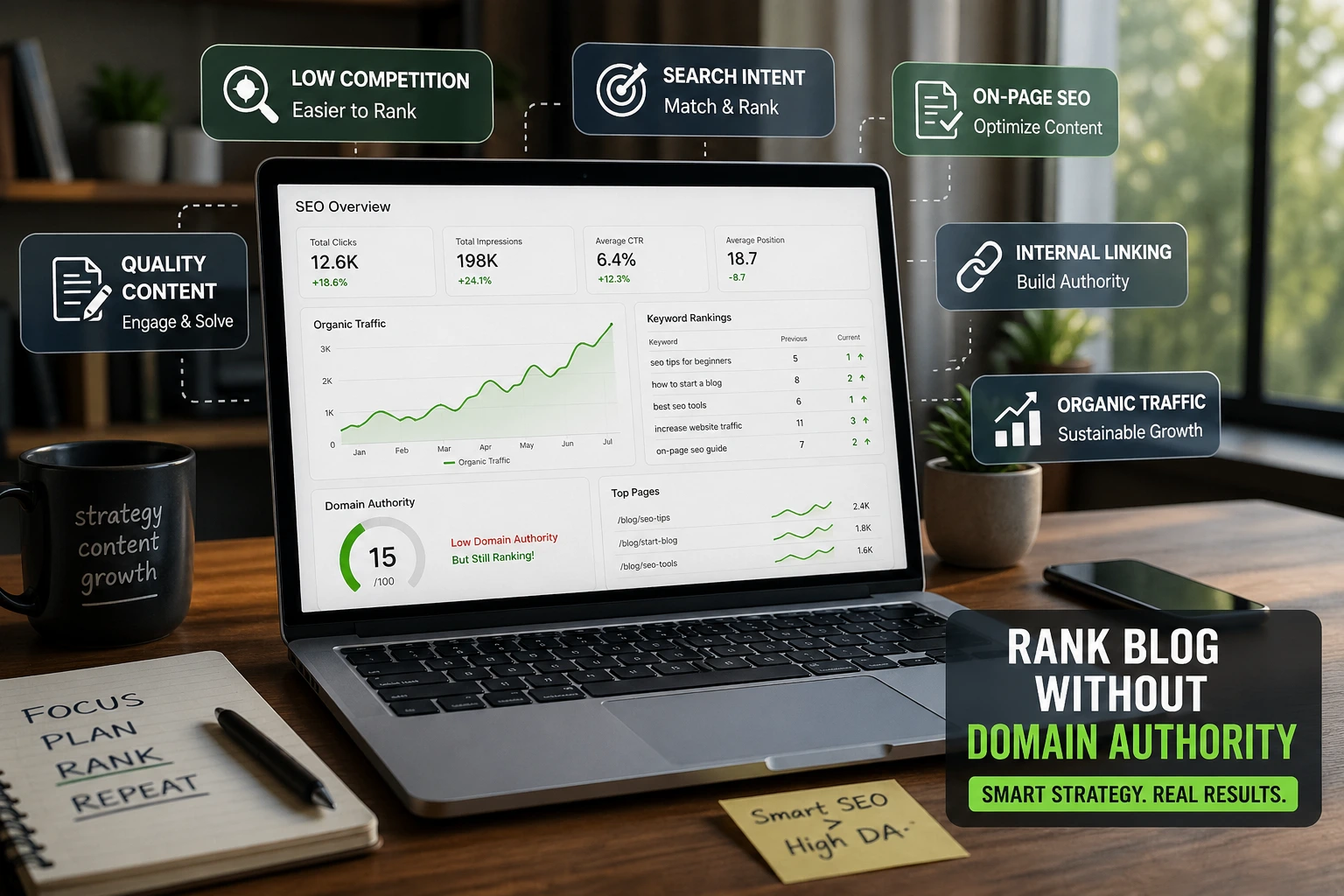
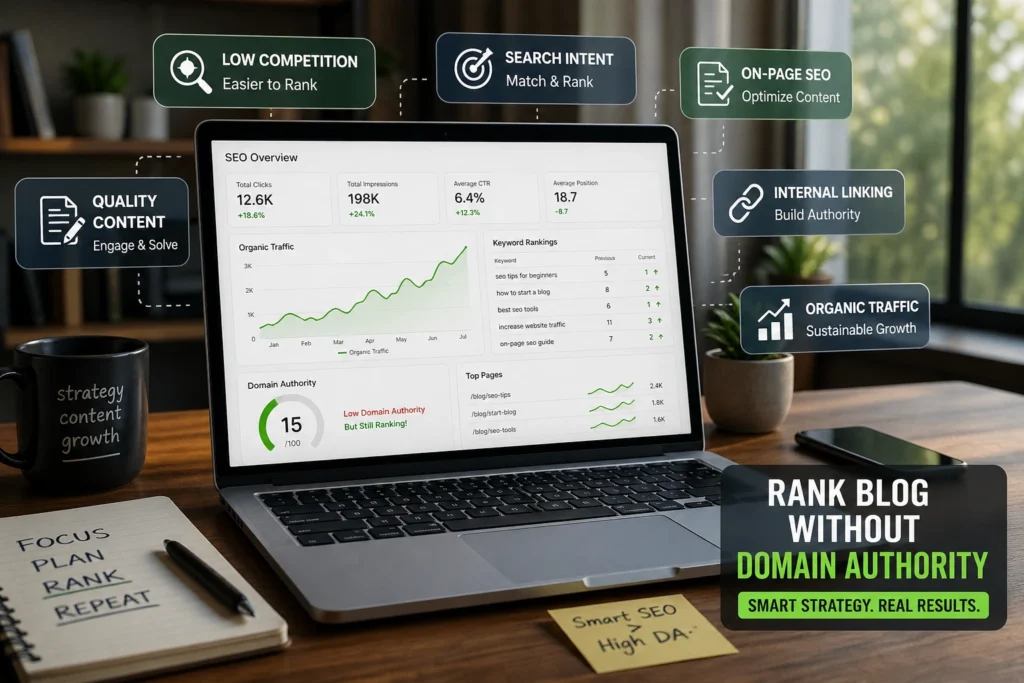
Most new bloggers run into the same wall. They write content, hit publish, and wait. Days pass. Then weeks.Still no traffic. The frustration sets in, and the common assumption is: “I need a high domain authority (DA) to rank on Google.”
That belief stops thousands of new bloggers before they even start. The good news? It is a myth.
The reality is that strategy beats authority every time, especially in the early stages. You do not need backlinks from high-authority websites or years of SEO history to rank your blog posts. You need the right approach.
On MarketingWithAk, the focus is on zero-budget SEO strategies that help beginners rank faster without relying on domain authority. This manual reveals precisely how to accomplish it.
What is Domain Authority and Does It Really Matter?
Domain Authority is a metric created by Moz, with a scale from 1 to 100. It predicts how likely a website is to rank in search engines based on factors like the number of backlinks and overall site trustworthiness.
Here is the most important thing most beginners get wrong: DA is NOT a Google ranking factor.
Google does not use Moz’s DA score to rank your content. Google has its own internal systems. What Google actually cares about is content relevance, search intent, page experience, and how well your content satisfies the user’s query.
Beginners confuse DA with actual Google ranking power. It is a useful metric for comparison, not a gatekeeper. A brand-new blog can absolutely outrank an older, high-DA site if the content is more relevant, better structured, and properly optimized.
Can You Rank Without Domain Authority? (Truth Explained)
Yes, you can. And it occurs more frequently than you realize.
New blogs rank every single day without backlinks or authority. Here is what makes it possible:
- Targeting low competition keywords that bigger sites ignore
- Matching user search intent precisely
- Using strong on-page SEO to signal relevance clearly
This is the exact approach applied on MarketingWithAk to rank new content quickly, without waiting years to build authority.
Why Most New Blogs Fail to Rank
Before applying the right strategy, it helps to understand what holds most new blogs back. These are the common SEO mistakes beginners make:
Targeting High Competition Keywords
New blogs try to rank for broad keywords like “digital marketing” or “SEO tips.” These are dominated by established sites with thousands of backlinks. A new blog has no chance competing here early on.
Ignoring Search Intent
Writing a blog post without understanding why someone is searching for that topic is a major mistake. Google prioritizes content that matches the user’s intent perfectly.
Thin Content with No Depth
Short, surface-level posts do not rank. Google rewards content depth and topical completeness.
No Internal Linking Strategy
Without linking related posts together, crawlability suffers and topical authority never builds.
Publishing Without a Strategy
Random posting without keyword clustering or a content plan wastes time and effort. Most beginners skip strategy entirely, which is where platforms like MarketingWithAk guide step-by-step execution.
Step-by-Step Strategy to Rank Without Domain Authority
This is the core of your SEO game plan. Follow these steps consistently and you will start seeing results even on a brand-new domain.
Step 1: Find Low Competition Keywords
Long-tail keywords are your best friends as a new blogger. Instead of targeting “SEO tips,” go for something like “how to rank blog without domain authority in 2026.” These are specific, easier to rank for, and attract users who know exactly what they need.
Focus on question-based queries and beginner intent keywords. Free tools like Google Search Console, Ubersuggest, and even Google’s autocomplete can help you find these opportunities. At MarketingWithAk, low competition keywords are always the starting point for any new content.
Step 2: Match Search Intent Perfectly
Search intent optimization is one of the most powerful and underused tactics. Before writing, ask: What does the person searching this keyword actually want?
Is it informational (learning something)? Is it transactional (buying something)? Analyze the top results for your target keyword and structure your content to serve the same intent, but better.
Step 3: Create Deep, Valuable Content
Content depth matters. A well-structured, detailed post that covers a topic completely will always outperform a thin 400-word article. Use H2 and H3 headings, include actionable steps, real examples, and semantic SEO to improve topical relevance.
Think of your content as the best answer to the user’s question available online. Cover every related subtopic, anticipate follow-up questions, and deliver clear, practical value.
Step 4: Smart Internal Linking Strategy
Internal linking is one of the most overlooked on-page SEO tactics. Every time you publish a new post, link it to relevant existing posts and vice versa. This builds topical authority within your blog, improves crawlability, and keeps users engaged longer.
This is a core strategy used across MarketingWithAk blog content to boost rankings without needing external backlinks.
Step 5: On-Page SEO Optimization
Never skip your on-page SEO checklist. This includes:
- Title tag: Include your primary keyword naturally
- Meta description: Write a clear, compelling 150-character summary
- Image alt text: Describe every image with relevant keywords
- Keyword placement: Use the primary keyword in the first 100 words, in one H2, and naturally throughout the content
Step 6: Improve User Engagement Signals
Google pays close attention to how users interact with your content. High bounce rates and short visit durations signal that your content is not satisfying the user’s need.
To improve engagement, keep sentences short, use clear subheadings, break up text with bullet points, and make your content easy to skim. Great readability keeps readers on the page longer.
How to Rank Without Backlinks (Zero Budget SEO Strategy)
You do not need a single backlink to start ranking. This might sound bold, but many blog posts rank on page one purely through quality content and smart structure.
The zero-budget SEO model is built on three pillars: high-quality content, strong internal links, and consistent publishing. When you consistently publish well-optimized posts around a specific topic, Google begins to recognize your blog as a relevant source for that niche.
This zero-budget SEO model is the foundation of MarketingWithAk’s organic traffic growth strategy. No paid tools. No backlink outreach. Just content that earns its rankings.
Realistic Timeline: How Fast Can You Rank?
One of the most common questions is: how long does SEO take? The honest answer depends on three factors:
- Keyword difficulty: Low competition keywords can rank in 7 to 30 days
- Content quality: Well-structured, in-depth posts rank faster
- Indexing speed: Submit your sitemap to Google Search Console to speed up indexing
For a brand-new blog targeting low competition keywords with strong on-page SEO, early rankings are achievable within the first month. Patience and consistency are the real secrets.
Common Mistakes That Kill Rankings
Even after applying the right strategy, small mistakes can hold back your progress. Watch out for these SEO mistakes:
- Keyword stuffing: Repeating the keyword unnaturally destroys readability and signals spam
- Writing without structure: Walls of text without headings confuse both users and search engines
- Ignoring user intent: Creating content that does not match what the searcher needs
- Not updating content: Old, outdated posts lose rankings over time without regular refreshes
Real Example: Ranking Without Domain Authority
Here is a practical example of how this strategy works in real life:
- Keyword used: “seo strategy for new blog with low domain authority”
- Strategy applied: Long-tail keyword targeting, strong on-page SEO, internal linking to three related posts
- Result: Page 1 ranking within 21 days, zero backlinks required
The content covered the topic in depth, used semantic keywords naturally, and matched search intent exactly. No paid tools. No outreach. Just strategy. This is similar to how content is built and scaled on MarketingWithAk.
Pro Tips to Rank Faster Without Authority
- Target zero search volume keywords: These are ultra-specific queries with little competition but real buyer or learner intent. They add up over time.
- Update content regularly: Refreshing old posts with new information signals freshness to Google.
- Build topic clusters: Create multiple related posts and interlink them. This builds niche authority across your entire blog.
- Focus on consistency: Publishing regularly signals to Google that your site is active and growing.
Build Topical Authority (Advanced Strategy)
Topical authority is when Google sees your blog as a reliable source on a specific subject. You earn this by creating a cluster of related content, not just one blog post.
For example, if your niche is SEO, you should have posts covering:
- How to get traffic without ads
- Low competition keyword research for beginners
- SEO for beginners: a step-by-step guide
Link all of these together using keyword clustering and smart internal linking. MarketingWithAk follows a cluster-based SEO model to build authority faster and rank multiple posts simultaneously.
Why Follow MarketingWithAk for SEO Growth
If you are serious about ranking your blog without spending money on ads or tools, MarketingWithAk is built for you. Here is what makes it different:
- Beginner-friendly strategies that are easy to apply immediately
- Zero-budget methods that do not require paid SEO tools
- Practical execution guides, not just theory
- Real ranking techniques tested on live blogs
If you want to grow your blog without relying on backlinks or authority, explore more guides on MarketingWithAk. Contact us or request a quote to learn how we can support your blog growth journey.
FAQs
Can a new blog rank without domain authority?
Yes. A new blog can rank by targeting low competition keywords, optimizing for search intent, and using strong on-page SEO. Domain authority is not a Google ranking factor.
How to rank without backlinks?
Focus on content quality, internal linking, keyword clustering, and consistent publishing. These factors alone can drive organic traffic growth without off-page SEO.
What is the fastest way to rank a blog?
Target long-tail, low competition keywords. Create in-depth, well-structured content that matches user intent. Submit your sitemap to Google Search Console to speed up indexing.
Does Google consider domain authority?
No. Google does not use Moz’s domain authority score. Google evaluates content quality, relevance, user engagement signals, and technical SEO factors.
How to find low competition keywords?
Use free tools like Google autocomplete, Answer the Public, and Ubersuggest. Look for question-based queries, niche-specific phrases, and long-tail variations with low search volume but clear user intent.
Conclusion
You do not need domain authority to rank your blog. You need strategy.
By targeting low competition keywords, matching search intent, creating deep content, building internal links, and staying consistent, any new blog can grow organically without spending a rupee on ads or tools.
The blogs that win are the ones that apply strategy, not the ones with the most authority. Start applying these techniques today.
Follow MarketingWithAk for more practical SEO methods that actually work. Get in touch today and let us help you build a blog that ranks.