
 June 5, 2026
  15 Min
  No Comment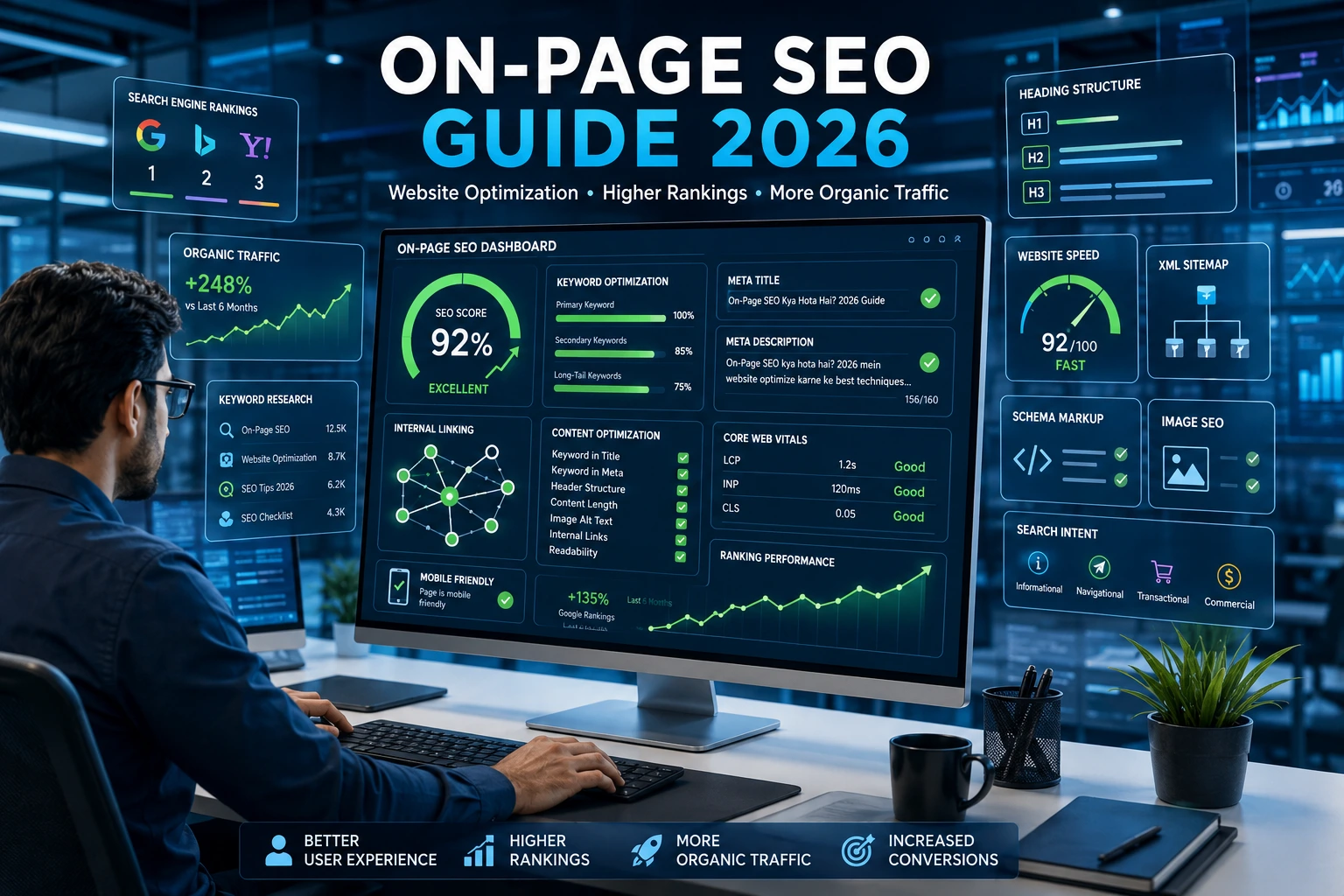
In 2026, search engines have become smarter, more context-aware, and far less tolerant of manipulative tactics. On-page SEO remains the single most powerful lever website owners can pull to improve organic rankings and attract the right audience. Whether you run a small business blog or a large e-commerce platform, getting your on-page fundamentals right is non-negotiable.
This guide walks you through every critical on-page SEO element with clear, actionable steps. From keyword placement to Core Web Vitals, from title tag best practices to internal linking architecture, you will find everything needed to build a well-optimized website that both Google and real users appreciate.
What Is On-Page SEO?
Definition
On-page SEO refers to the practice of optimizing individual web pages so that search engines can accurately understand their content, relevance, and quality. It covers everything visible on a page, such as the written content, headings, images, and structured data, as well as the HTML source code elements like title tags, meta descriptions, and canonical URLs.
Unlike off-page SEO, which depends on external signals such as backlinks and brand mentions from other websites, on-page SEO is entirely within your control. Every element you optimize on your own site contributes directly to how search engines evaluate your pages.
The Core Objective of On-Page SEO
The primary goal is to align your page content with what users are actually searching for and to make that content easy for search engines to crawl, understand, and rank. A well-optimized page achieves better search visibility, higher click-through rates from the results page, and a smoother user experience that keeps visitors engaged longer.
In practical terms, on-page SEO bridges the gap between what your audience needs and what search engines reward.
On-Page SEO vs. Off-Page SEO: Key Differences
Both disciplines contribute to search rankings, but they operate in fundamentally different ways. Understanding their distinctions helps you allocate effort more strategically.
On-Page SEO
Focuses entirely on elements within your website. You have direct control over every optimization decision, from rewriting a title tag to restructuring a content outline or fixing a broken internal link.
Off-Page SEO
Refers to actions taken outside your website, primarily building backlinks from authoritative sources, earning brand mentions, and strengthening domain authority. These signals are harder to control and take longer to influence rankings.
Quick Comparison
Factor | On-Page SEO | Off-Page SEO |
Focus Area | Website content and HTML elements | Backlinks and external signals |
Control Level | Full control by website owner | Partial — depends on third parties |
Ranking Impact | Directly affects crawl and indexation | Builds domain authority over time |
Key Actions | Title tags, headings, meta, content | Link building, brand mentions, PR |
Time to Impact | Relatively faster | Slower but long-lasting |
Top On-Page Ranking Factors in 2026
1. Search Intent Optimization
Google’s algorithm in 2026 is exceptionally good at detecting whether a page actually satisfies the user behind a query. Search intent falls into four main categories: informational (the user wants to learn something), navigational (the user wants to reach a specific site), transactional (the user wants to buy or sign up), and commercial (the user is comparing options before a decision).
Before writing a single word, identify which intent your target keyword carries. If you target a transactional keyword with an informational article, you will struggle to rank regardless of how well you execute the other technical elements.
2. Content Quality and E-E-A-T
Google evaluates content through the lens of Experience, Expertise, Authoritativeness, and Trustworthiness, commonly referred to as E-E-A-T. This framework was originally introduced for health, finance, and legal topics but now applies broadly across all niches.
- Experience: Demonstrate firsthand knowledge. Share real results, case studies, or personal observations.
- Expertise: Show depth of subject matter understanding through accurate, comprehensive information.
- Authoritativeness: Build credibility through author bios, credentials, citations, and recognition within your industry.
- Trustworthiness: Maintain clear privacy policies, transparent authorship, and accurate, up-to-date information.
3. User Experience (UX)
A page that is difficult to read, cluttered, or confusing will see high bounce rates and short dwell times. These behavioral signals influence how Google perceives the quality of your page. Prioritize clean layout, scannable content with proper heading hierarchy, adequate font sizes, and logical navigation paths.
4. Mobile-First Indexing
Google has fully adopted mobile-first indexing, meaning the mobile version of your page is what gets evaluated for ranking purposes. Your website must be fully responsive, with touch-friendly buttons, legible text without pinch-zooming, and fast loading performance on mobile data connections.
5. Core Web Vitals
Core Web Vitals are a set of measurable page experience signals that Google uses as direct ranking inputs. In 2026, the three key metrics remain:
- Largest Contentful Paint (LCP): Measures loading performance. Target under 2.5 seconds.
- Interaction to Next Paint (INP): Measures responsiveness to user interactions. Target under 200 milliseconds.
- Cumulative Layout Shift (CLS): Measures visual stability. Target a score below 0.1.
Keyword Research and Strategic Placement
Selecting the Right Keywords
Effective on-page SEO begins with intelligent keyword selection. Every page should target one primary keyword that represents the central topic, two to four secondary keywords that support related subtopics, and a handful of long-tail variants that capture more specific search queries. Tools like Google Search Console, Ahrefs, Semrush, or even Google Suggest can help you discover these keyword families.
Avoid targeting keywords with intent mismatches. If your page is a product listing, do not try to rank for an informational how-to query.
Keyword Placement Checklist
- SEO Title Tag: Primary keyword as close to the beginning as possible
- URL Slug: Include the primary keyword in a clean, concise URL
- Meta Description: Mention the keyword naturally while keeping it engaging
- H1 Tag: Must contain the primary keyword exactly once
- H2 and H3 Headings: Include secondary keywords and long-tail variants naturally
- First 100 Words: Introduce the primary keyword within the opening paragraph
- Image Alt Text: Describe images with keyword-relevant language
- Conclusion Paragraph: Reinforce the topic with a natural mention
Avoiding Keyword Stuffing
Keyword stuffing is the practice of artificially inflating keyword density to manipulate rankings. It makes content awkward to read and violates Google search quality guidelines. A general rule of thumb: if reading a sentence aloud feels unnatural, rewrite it. Focus on topical coverage and user clarity over exact keyword repetition.
How to Write SEO-Friendly Content
Content Structure Optimization
A well-structured page uses a clear heading hierarchy: one H1 for the page title, multiple H2 headings for main sections, and H3 or H4 tags for subsections within those sections. This structure helps both readers and search engine crawlers navigate your content logically.
Improving Readability
Write for humans first and optimize for search engines second. Use short paragraphs of three to four sentences. Break up long sections with subheadings, bullet lists, or numbered steps. Avoid dense walls of text. Use conversational but professional language and explain complex terms whenever you introduce them.
Semantic SEO and LSI Keywords
Modern search engines understand context and topical relationships. Semantic SEO means covering your main topic comprehensively by including related concepts, synonyms, and contextually relevant terms throughout the content. If your article covers Core Web Vitals, naturally mentioning LCP, CLS, page speed, and user experience signals helps Google understand topical depth, even if those exact phrases are not your target keywords.
Content Freshness
Search engines favor content that stays current. Review your highest-performing pages every six to twelve months. Update statistics, refresh examples, remove outdated tools or references, and add newly relevant information. Even minor updates can trigger a re-crawl that improves rankings for pages that have started to decline.
Title Tag and Meta Description Optimization
SEO Title Best Practices
The title tag is the single most important HTML element for on-page SEO. It tells search engines what your page is about and it appears as the clickable headline in search results. Keep it between 50 and 60 characters to prevent truncation in Google search results. Place the primary keyword near the beginning. Add your brand name at the end when space allows. Make it compelling enough to earn a click over competing results.
Meta Description Writing Tips
While meta descriptions are not a direct ranking signal, they significantly affect click-through rates, which does influence rankings indirectly. Write descriptions between 150 and 160 characters. Match the search intent of the target keyword. Include a clear call to action such as learn, discover, get started, or explore. Naturally incorporate the primary keyword so Google highlights it in the search snippet.
Common Mistakes to Avoid
- Leaving meta descriptions blank or auto-generated from random page content
- Writing titles that are too vague, clickbait-style, or stuffed with keywords
- Using the same title or description across multiple pages
- Exceeding character limits and having content cut off in search results
URL Structure Optimization
What Makes a URL SEO-Friendly?
A clean URL tells both users and search engines immediately what a page is about. The best SEO URLs are short and descriptive, use lowercase letters only, separate words with hyphens rather than underscores, include the target keyword, and avoid unnecessary parameters, numbers, or special characters.
URL Optimization Examples
Good URL: yourwebsite.com/on-page-seo-guide
Avoid: yourwebsite.com/page?id=12345&cat=blog&ref=home
Keep URLs as short as possible while still being descriptive. Remove stop words like and, the, or of unless they are essential to clarity.
Common URL Errors
- Dynamic URLs with query strings that confuse crawlers
- Excessively long URLs with multiple subdirectories
- Uppercase letters or special characters that cause redirect issues
- Changing URLs without setting up proper 301 redirects
Header Tags Optimization (H1, H2, H3)
Why Header Structure Matters
Header tags create a content hierarchy that helps both human readers and search engine bots understand the organization of your page. From an SEO perspective, heading tags carry semantic weight that signals topic relevance and page structure. From a user experience perspective, well-organized headings allow readers to scan content and jump to sections most relevant to them.
Proper Heading Hierarchy
- H1: Used exactly once per page, containing the primary keyword and reflecting the page topic
- H2: Used for major sections, incorporating secondary keywords naturally
- H3: Used for subsections within H2 sections, covering long-tail or related keyword themes
- H4 and below: Used sparingly for detailed breakdowns within subsections
Image SEO Optimization
File Names
Before uploading an image, rename it with a descriptive, keyword-relevant file name using hyphens to separate words. Instead of IMG_4829.jpg, use on-page-seo-checklist-2026.jpg. This gives search engines an important contextual clue about what the image depicts.
Alt Text Optimization
Alt text serves two purposes: it helps visually impaired users understand images through screen readers, and it helps search engines understand what an image shows. Write alt text as a natural, descriptive phrase that reflects the image content. Include the target keyword where it genuinely fits. Avoid generic phrases like image1 or photo of website.
Image Compression and Format
Large, uncompressed images are one of the most common causes of slow page load times, which directly hurts both Core Web Vitals scores and user experience. Compress all images before uploading using tools like Squoosh, ShortPixel, or TinyPNG. Use the WebP format where possible, as it delivers significantly better compression ratios than JPEG or PNG while maintaining visual quality. Always define explicit width and height attributes to prevent layout shifts.
Internal Linking Strategy
What Are Internal Links?
Internal links are hyperlinks that connect one page on your website to another page on the same domain. They serve multiple purposes: they help search engine crawlers discover and index new content, they distribute page authority (sometimes called link equity) across your site, and they guide users toward relevant content that deepens their engagement.
Internal Linking Best Practices
- Use descriptive, keyword-relevant anchor text rather than generic phrases like click here or read more
- Link from high-authority pages to newer or lower-ranking pages that need a boost
- Ensure every important page can be reached within three clicks from the homepage
- Avoid excessive internal links on a single page, which dilutes their individual SEO value
- Regularly audit for and fix broken internal links using tools like Screaming Frog or Google Search Console
Topic Clusters and Content Silos
A topic cluster strategy organizes your content around a central pillar page that covers a broad topic comprehensively, with multiple cluster pages diving deep into specific subtopics. Each cluster page links back to the pillar, and the pillar links out to each cluster. This architecture signals topical authority to search engines and creates a logical, easy-to-navigate structure for users.
Technical On-Page SEO Elements
Schema Markup
Schema markup is structured data added to your HTML using vocabulary from Schema.org. It helps search engines understand the specific type of content on a page. Implementing schema can enable rich results in Google search, including star ratings, FAQ dropdowns, breadcrumb trails, and article publication dates. These rich results increase visibility and click-through rates without directly changing rankings.
Canonical Tags
A canonical tag tells search engines which version of a page is the preferred original. This is critical for preventing duplicate content penalties when the same content is accessible through multiple URLs, such as with URL parameters, pagination, or similar product pages on e-commerce sites.
XML Sitemap and Crawlability
An XML sitemap lists all the important pages on your site and helps search engines discover and prioritize them for crawling. Submit your sitemap through Google Search Console. Pair this with a well-configured robots.txt file to block crawlers from indexing low-value pages like admin panels, thank-you pages, or internal search results.
Website Speed Optimization for SEO
Why Page Speed Is a Ranking Factor
Page speed directly impacts user satisfaction. Research consistently shows that visitors abandon pages that take more than three seconds to load. Google uses page speed as a confirmed ranking signal, and slow pages tend to see higher bounce rates and lower engagement metrics, both of which indirectly suppress rankings.
Practical Speed Improvement Techniques
- Compress and convert all images to WebP format
- Enable browser caching so returning visitors load pages faster
- Use a Content Delivery Network (CDN) to serve assets from servers closest to the user
- Minify CSS, JavaScript, and HTML files to reduce file sizes
- Defer or async load non-critical JavaScript so it does not block page rendering
- Use lazy loading for images and videos below the fold
Core Web Vitals Monitoring Tools
- Google Search Console: Free, shows real-user CWV data for your site
- PageSpeed Insights: Provides lab and field data with specific fix recommendations
- Lighthouse: Built into Chrome DevTools for detailed performance audits
- GTmetrix: Combines multiple performance metrics in one report
On-Page SEO Checklist for 2026
Use this checklist before publishing any new page and when auditing existing content.
Content & Technical | UX & Performance |
☑ Target keyword in H1 and first 100 words | ☑ Mobile responsive design verified |
☑ SEO title under 60 characters with keyword | ☑ LCP under 2.5 seconds |
☑ Meta description 150-160 characters, action-driven | ☑ INP under 200 milliseconds |
☑ URL is short, lowercase, keyword-rich | ☑ CLS score below 0.1 |
☑ All images have descriptive alt text | ☑ HTTPS and no mixed content |
☑ Schema markup added (Article, FAQ, BreadcrumbList) | ☑ XML sitemap submitted in Search Console |
☑ Internal links point to relevant pages | ☑ Canonical tags set correctly |
☑ Content covers E-E-A-T signals clearly | ☑ No duplicate meta tags or thin content |
Common On-Page SEO Mistakes to Avoid
Keyword Stuffing
Cramming keywords into every sentence creates unreadable content and triggers Google quality filters. Write naturally and use keyword variations, synonyms, and related terms to cover the topic without forced repetition.
Duplicate Content
Publishing the same or very similar content across multiple pages confuses search engines about which version to rank. Use canonical tags, consolidate thin pages, and ensure each page offers genuinely unique value.
Missing or Poorly Written Meta Tags
Empty or auto-generated meta titles and descriptions represent missed opportunities to communicate relevance to search engines and entice clicks from potential visitors. Every page deserves a handcrafted, intent-matched meta title and description.
Poor Internal Linking
Orphan pages with no internal links pointing to them are essentially invisible to search engines. Audit your site regularly and build intentional internal link paths to every page that matters.
Ignoring Mobile Users
With Google operating on a mobile-first index, a desktop-only optimized website is a website that ranks poorly. Test every page on real mobile devices and using Google Mobile-Friendly Test to identify usability issues.
Conclusion
On-page SEO in 2026 is not about gaming an algorithm. It is about creating clear, helpful, technically sound web pages that make it easy for people and search engines alike to understand your content, trust your expertise, and take the action you are guiding them toward.
The fundamentals have stayed consistent: write for intent, structure content clearly, optimize every technical element, and deliver a fast and accessible experience on every device. What has changed is the standard. Search engines are smarter, competition is higher, and mediocre content simply does not rank anymore.
Start with one page. Audit it against the checklist above, fix what is broken, improve what is weak, and build forward from there. Consistent on-page SEO effort compounds over time into lasting organic visibility that no paid ad budget can replicate.
Frequently Asked Questions
Q1. What is on-page SEO?
On-page SEO is the process of optimizing website content, HTML elements such as title tags and meta descriptions, headings, images, and user experience factors so that search engines can accurately evaluate page relevance and rank it for appropriate search queries.
Q2. What is the difference between on-page and off-page SEO?
On-page SEO covers all optimization activities carried out within your own website. Off-page SEO refers to external factors like earning backlinks and brand mentions from other websites that build your domain authority in the eyes of search engines.
Q3. What are the most important on-page SEO factors in 2026?
Search intent alignment, content quality with strong E-E-A-T signals, a well-structured heading hierarchy, optimized title tags and meta descriptions, clean URL structure, image SEO, strategic internal linking, mobile-first design, and strong Core Web Vitals scores are the most critical on-page factors.
Q4. Does keyword stuffing hurt SEO?
Yes. Keyword stuffing degrades content readability, violates Google search quality guidelines, and can result in manual or algorithmic ranking penalties. Use keywords naturally and focus on comprehensive topical coverage rather than high keyword frequency.
Q5. How does internal linking help SEO?
Internal linking helps search engine crawlers discover and index pages more efficiently, distributes link equity across your site to boost lower-authority pages, and keeps users navigating deeper into your content, which improves engagement signals that indirectly support rankings.
Q6. How important are Core Web Vitals for Google rankings in 2026?
Core Web Vitals are an official Google ranking signal and directly affect both rankings and user experience. Achieving strong LCP, INP, and CLS scores demonstrates that your site is fast, responsive, and visually stable, all of which Google rewards with better search visibility.