
 June 3, 2026
  14 Min
  No Comment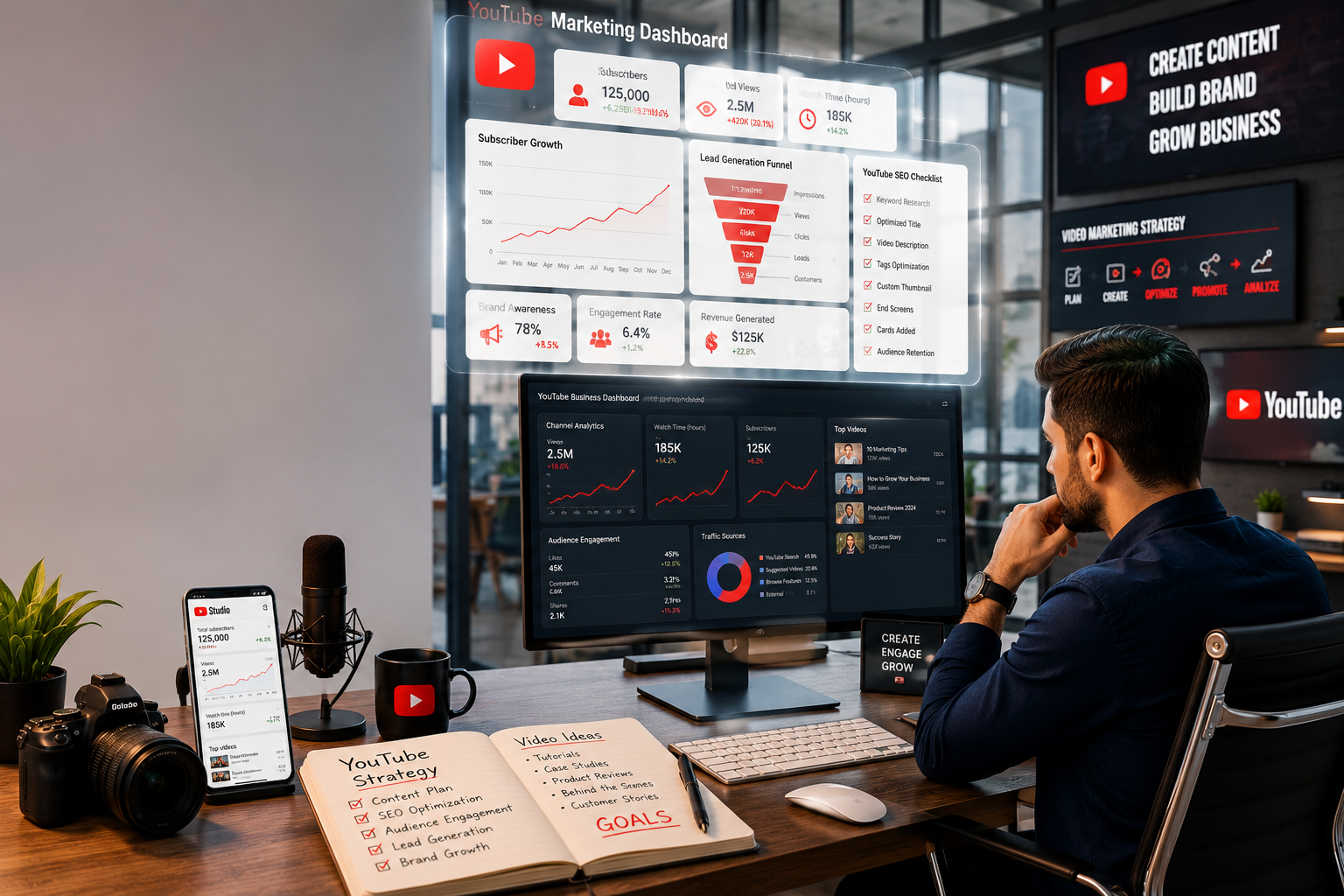
Video has permanently changed how people discover, evaluate, and buy from businesses. With over 2.7 billion logged-in users every month and more than 500 hours of video uploaded every single minute, YouTube sits at the center of modern digital marketing. For any business serious about online visibility, leads, and sales, building a presence here is no longer optional.
This guide walks through everything you need to know about YouTube video marketing, from building a strategy from scratch to running paid campaigns and measuring what actually matters.
What Is YouTube Marketing for Business?
YouTube marketing is the practice of using video content, channel optimization, and advertising on YouTube to attract potential customers, build credibility, and grow revenue. It sits at the intersection of content marketing, search engine optimization, and paid advertising.
A business YouTube channel can serve multiple purposes simultaneously. It educates prospective buyers, supports existing customers, builds brand authority, and generates organic traffic week after week. Unlike social media posts that disappear within hours, a well-optimized YouTube video continues attracting views and leads for years after publication.
Why Businesses Should Invest Here
The case for investing in YouTube business strategy is straightforward. Video content consistently outperforms text-based content on engagement and retention metrics. Viewers retain roughly 95% of a message delivered through video compared to about 10% through reading. Beyond engagement, YouTube functions as a search engine, meaning your content can rank for high-intent commercial queries that bring buyers directly to your videos.
For small businesses and startups especially, YouTube levels the playing field. A well-produced tutorial from an independent consultant can outrank a Fortune 500 company’s corporate video simply by being more useful and better optimized.
Why YouTube Is a Powerful Marketing Platform
YouTube as the Second Largest Search Engine
Google owns YouTube, and the two platforms are deeply integrated. Videos frequently appear in Google search results, giving your content dual exposure. When someone searches “how to fix a leaking pipe” or “best accounting software for freelancers,” YouTube videos appear prominently in results. This makes YouTube channel SEO an extension of your broader search strategy, not a separate effort.
Search behavior data confirms that video consumption continues rising across every demographic. Younger buyers in particular use YouTube as their primary research tool before making purchase decisions.
How YouTube Influences Buying Decisions
Purchase decisions rarely happen in isolation. Buyers move through a research process, and YouTube plays a central role in that journey. Product demonstrations, detailed reviews, side-by-side comparisons, and unboxing videos all serve as trust signals that help buyers feel confident before committing.
For B2B companies, this is equally relevant. Decision-makers watch webinar recordings, expert interviews, and case study presentations on YouTube to evaluate vendors and solutions. Thought leadership content on a well-maintained business channel builds the kind of authority that shortens sales cycles.
Creating a Successful YouTube Marketing Strategy
Strategy before production. Many businesses jump straight into filming without defining what success looks like, who they are talking to, or how their content connects to business outcomes. That approach wastes time and money.
Define Your Business Goals
Your YouTube business strategy needs to anchor to specific goals. Common objectives include building brand awareness with new audiences, generating qualified leads for sales teams, driving traffic to landing pages and product pages, educating existing customers to reduce churn, and establishing thought leadership in a competitive niche.
Each goal requires a different content approach and a different set of metrics. A channel built for awareness will look very different from one built for lead generation.
Identify Your Target Audience
Effective YouTube content strategy starts with a precise understanding of who you are making videos for. Go beyond broad demographics and get specific about the problems your audience is actively trying to solve. What questions do they type into search? What obstacles do they face at each stage of their customer journey? What type of content do they already watch and trust?
YouTube Analytics provides detailed audience data once your channel has traction, but early on you can pull insights from Google Analytics, your CRM, and competitor channel comments.
Competitor Analysis
Study channels in your niche that are already performing well. Look at their most-watched videos, the titles they use, comment sentiment, and the content gaps they are leaving. Every underserved question in your industry is a content opportunity. You do not need to copy anyone. You need to find the angles they are missing and serve your audience better.
Build a Content Plan
Consistency drives YouTube growth more than any single viral video. Build a realistic publishing schedule you can maintain for at least six months. Map your content categories to your marketing funnel: awareness content attracts new viewers, consideration content nurtures them toward a decision, and conversion content closes.
Types of YouTube Videos That Drive Business Growth
Educational Videos and Tutorials
Tutorial and how-to videos are among the highest-performing content types for businesses across industries. They attract people who are actively searching for solutions, which means the audience is already warm. A software company publishing step-by-step tutorials serves both new users and prospects evaluating their product simultaneously.
Product Demonstrations
Showing your product or service in action removes purchase hesitation far more effectively than written descriptions. Demos let prospects see exactly what they are buying, which reduces returns and increases buyer confidence. For eCommerce businesses especially, video demonstrations directly influence conversion rates.
Customer Testimonials
Social proof is one of the most powerful conversion tools available. Video testimonials carry more weight than text reviews because viewers can read body language, hear tone of voice, and connect emotionally with real customers sharing genuine results. Businesses that feature client success stories on YouTube consistently see higher trust scores and lower cost per lead.
Case Studies and Behind-the-Scenes Videos
Case study videos documenting real client outcomes give prospects a clear picture of what working with you delivers. Behind-the-scenes content humanizes your brand and builds the kind of emotional connection that turns viewers into long-term community members.
YouTube Shorts for Business
Shorts are YouTube’s short-form vertical video format, and they are among the fastest ways to increase reach and visibility. The algorithm actively promotes Shorts to new audiences, making them valuable for top-of-funnel brand awareness. Use Shorts to repurpose key moments from longer videos, answer common questions quickly, or introduce your team and brand personality.
YouTube SEO for Business Videos
YouTube SEO determines whether your videos get found organically. Publishing without optimizing is like opening a store with no sign on the door.
Keyword Research for YouTube
Finding the right keywords means understanding what your audience actually searches for, not what you think they search for. Tools like YouTube’s autocomplete, Google Trends, and keyword research platforms help identify high-intent phrases with genuine search volume. Prioritize keywords that signal buying intent or problem awareness, as these attract viewers who are most likely to become customers.
Optimize Video Titles, Descriptions, and Tags
Your title needs to include your primary keyword while being genuinely compelling enough to earn a click. Avoid clickbait. Titles that promise what the video actually delivers build trust and reduce bounce rates.
Descriptions should explain what the video covers in natural language, include relevant keywords without forcing them, and always feature a clear call-to-action. Link to your landing pages, lead magnets, and related content. Use hashtags strategically to help the algorithm place your content in relevant feeds.
Tags help YouTube understand your content’s context. Use a mix of specific and broad tags that accurately describe your topic.
Design High-Converting Thumbnails
Thumbnails are the single most influential factor in click-through rate. A strong thumbnail communicates the video’s value instantly, stands out visually in a crowded feed, and creates curiosity. Use consistent visual branding across your thumbnails to build recognition. Test different thumbnail designs using YouTube’s built-in A/B testing tool.
Improve Watch Time and Audience Retention
The YouTube algorithm rewards videos that keep viewers watching. Improve retention by opening with a strong hook in the first 15 seconds, structuring your content with clear logical flow, cutting anything that does not serve the viewer, and using pattern interrupts like graphics, cuts, and demonstrations to maintain engagement. The longer people stay, the more the algorithm distributes your content to new audiences.
How to Optimize Your YouTube Business Channel
Your channel itself needs the same attention as your individual videos.
Set up a professional channel banner that communicates your value proposition immediately. Write a thorough About section using natural language that includes relevant keywords and explains exactly who your channel serves and why. Organize your content into playlists by topic or funnel stage to improve user experience and session watch time.
Add clear calls-to-action throughout your channel, including in video end screens, cards, channel banners, and the About section. Make it frictionless for viewers to visit your website, sign up for a newsletter, or book a consultation.
Brand authority grows through consistency. Regular publishing, professional production, and a clear editorial perspective signal to both viewers and the algorithm that your channel is a reliable resource.
Using YouTube for Lead Generation
YouTube lead generation works when you give viewers a compelling reason to take the next step.
Lead magnets tied to video content perform exceptionally well. Offer a free guide, checklist, template, or consultation that extends the value of the video and is genuinely useful. Mention the offer naturally within the video and include the link prominently in the description and pinned comment.
Drive traffic to dedicated landing pages rather than generic homepages. Viewers who click through from a specific video are in a defined mindset. A landing page that matches the intent of the video converts at a much higher rate than a generic destination.
For longer-term customer acquisition, think of YouTube as a nurturing engine. A viewer who watches three or four of your videos is warming up significantly. Retargeting campaigns that reach these engaged viewers with a specific offer can dramatically lower your cost per lead.
YouTube Advertising for Business Growth
Organic growth takes time. YouTube advertising delivers faster results by putting your content in front of targeted audiences immediately.
The main ad formats available include skippable in-stream ads that play before or during videos and can be skipped after five seconds, non-skippable ads of 15-20 seconds that viewers must watch in full, in-feed ads that appear in search results and recommended feeds, and Shorts ads that run between Shorts in the feed.
Each format suits different goals. Skippable ads work well for brand storytelling and retargeting. In-feed ads are effective for capturing high-intent audiences who are actively searching. Non-skippable ads maximize message delivery for product launches or time-sensitive promotions.
YouTube advertising gives access to Google’s full targeting stack, including demographics, interests, life events, custom intent audiences built from search behavior, and remarketing lists. This precision makes YouTube ads a cost-efficient channel for customer acquisition when campaigns are managed well.
For budgeting, start with a clear hypothesis about cost per lead targets, set a test budget over 30 days, and optimize based on view-through rates, click-through rates, and downstream conversion data rather than views alone.
Measuring YouTube Marketing Success
Vanity metrics mislead. Views feel good but tell you nothing about business outcomes. Measure what connects to revenue.
Key YouTube analytics metrics to track include average view duration and audience retention percentages (which reveal content quality), click-through rate on thumbnails (which reveals creative effectiveness), subscriber growth rate, and traffic source data (which shows where your viewers are coming from).
For lead generation, track website sessions from YouTube, form completions, and cost per lead from both organic and paid efforts. For eCommerce businesses, set up proper UTM tracking and attribution so you can measure revenue generated from YouTube traffic directly.
Business growth KPIs like customer acquisition cost, customer lifetime value from YouTube-sourced customers, and overall marketing ROI give you the data needed to allocate budget confidently and make the case for expanding your video marketing investment.
Common YouTube Marketing Mistakes to Avoid
Inconsistent publishing is the most common reason channels fail to grow. The algorithm favors channels that publish regularly and retain viewers. A burst of ten videos followed by three months of silence resets your momentum.
Ignoring YouTube SEO leaves enormous amounts of organic traffic on the table. Optimization takes an extra hour per video and compounds dramatically over time.
Weak or absent calls-to-action mean viewers watch and leave without taking any action. Every video needs a clear next step.
Focusing only on view counts rather than engagement quality, retention, and downstream conversions leads to a content strategy that optimizes for the wrong outcomes. One thousand highly engaged viewers who visit your website are worth far more than one hundred thousand passive viewers who click away in thirty seconds.
Advanced YouTube Marketing Tips for 2026
Repurpose existing long-form content into Shorts, social media clips, blog posts, and email newsletter features to multiply the value of every video you produce. A 20-minute tutorial can yield a dozen pieces of derivative content.
Collaborating with influencers and established creators in your niche provides access to built audiences and signals credibility to both viewers and the algorithm. Prioritize collaborators whose audiences genuinely overlap with your customer profile.
AI tools for content planning, scripting assistance, and thumbnail testing have matured significantly. Use them to identify content gaps, analyze competitor performance, and streamline production workflows without sacrificing the authentic human voice that builds real audience relationships.
Audience retention signals have become increasingly important ranking factors. Videos that hold 60-70% of viewers to the end consistently outperform longer, lower-retention videos even when the shorter videos have fewer total views. Tight editing is not optional.
Conclusion
YouTube remains one of the most powerful and cost-efficient channels available for business growth in 2026. The combination of search-driven organic discovery, social sharing potential, and sophisticated advertising targeting creates an environment where businesses of all sizes can compete effectively.
Success requires treating YouTube as a long-term asset rather than a short-term campaign. Build your YouTube business channel with clear goals, produce content your audience genuinely needs, optimize every video for search, and measure performance against real business outcomes. The businesses seeing the strongest results are those that integrate YouTube SEO, organic content marketing, and paid advertising into a coherent, data-driven strategy.
Start with your audience’s most pressing questions. Build from there.
Frequently Asked Questions
What is YouTube marketing for business?
YouTube marketing for business involves using video content, channel optimization, YouTube SEO, and advertising to increase brand awareness, generate leads, and drive sales. It combines organic content strategy with paid video promotion to grow audiences and revenue.
How can YouTube help grow a business?
YouTube helps businesses attract new customers through search-driven video discovery, builds trust through demonstrations and testimonials, improves online visibility by ranking on both YouTube and Google, and generates leads through strategic calls-to-action and lead magnets tied to video content.
Is YouTube marketing effective for small businesses?
Yes. YouTube allows small businesses to reach targeted audiences without requiring a massive marketing budget. A well-optimized video on a focused niche topic can outrank larger competitors and continue generating organic traffic for years.
What types of videos work best for business marketing?
Educational tutorials, product demonstrations, customer testimonials, case studies, and YouTube Shorts consistently deliver strong engagement and business results. The best-performing videos directly address specific questions or problems that target customers are actively searching for.
How important is YouTube SEO for business videos?
YouTube SEO is critical. Without proper optimization of titles, descriptions, thumbnails, and watch time signals, even excellent video content will not be discovered. Strong YouTube channel SEO increases visibility across both YouTube search and Google search results simultaneously.
How long does it take to see results from YouTube marketing?
Results vary based on content quality, publishing consistency, competition, and how well videos are optimized. Many businesses begin seeing measurable growth in website traffic and lead generation within three to six months of consistent publishing and active SEO optimization.