
 April 23, 2026
  6 Min
6 Min  No Comment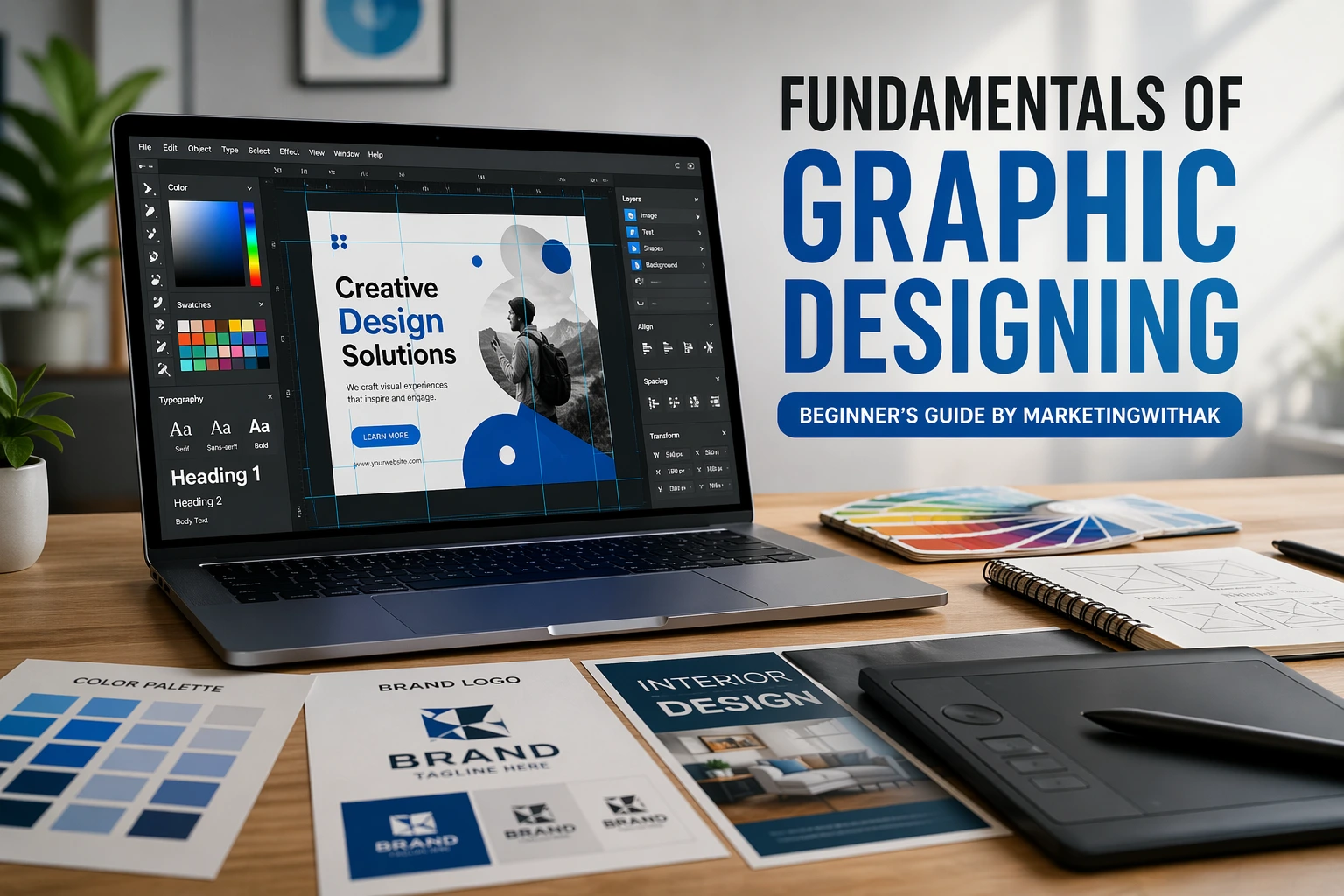
Most beginners open Canva or Photoshop on day one. That is the biggest mistake. Real designers learn fundamentals first, tools second.
Graphic design fundamentals are the rules behind every great visual. Without them, even expensive software produces weak results. At MarketingWithAK, we teach skill-first, not tool-first.
This guide covers everything you need to start strong.
What is Graphic Designing?
Graphic designing is the art of visual communication. It combines text, images, and color to deliver a message clearly.
It appears everywhere: social media posts, logos, websites, ads, and packaging. Businesses use graphic design to attract customers and build trust.
Good design is not just about beauty. It solves problems and guides decisions.
Why Are the Fundamentals of Graphic Designing Important?
Skipping fundamentals creates weak, inconsistent designs. Learning them builds a strong creative foundation.
Here is why fundamentals matter:
- You make faster design decisions
- You reduce errors and revisions
- You create professional-looking work from the start
- You understand why a design works, not just how it looks
At MarketingWithAK, every lesson connects fundamentals to real-world marketing results.
Core Principles of Graphic Design
These are the must-know concepts every beginner needs to master.
Color Theory
Color is emotion in visual form. The color wheel shows relationships between primary, secondary, and tertiary colors.
Color psychology matters in marketing. Blue builds trust. Red creates urgency. Yellow grabs attention.
Use complementary or analogous color combinations for balanced, attractive designs.
Typography Basics
Typography is not just choosing a font. It controls how readers experience your content.
There are three main font types: serif, sans-serif, and script. Serif fonts feel traditional. Sans-serif fonts feel modern and clean.
Always pair fonts with contrast. Example: bold heading font + simple body font.
Layout and Composition
Layout decides where every element lives on a page. Poor layout confuses the viewer immediately.
Use grid systems to align elements neatly. Apply the rule of thirds to create visual interest. Consistent spacing makes designs breathable.
Balance and Contrast
Balance creates visual stability. You can use symmetrical balance for formal designs or asymmetrical balance for dynamic ones.
Contrast separates important elements from the background. It directs the viewer’s eye to the right place first.
White Space (Negative Space)
White space is not empty space. It is a design tool. It gives designs room to breathe.
Cluttered designs overwhelm viewers. White space creates clarity, focus, and a premium feel.
Visual Hierarchy
Visual hierarchy tells viewers what to look at first, second, and third. It guides attention intentionally.
Use size, color, and placement to rank elements by importance. CTA buttons should always sit high in the visual hierarchy.
Essential Graphic Design Tools for Beginners
You do not need all tools at once. Start simple and build up.
Canva is best for beginners. It has drag-and-drop features and ready-made templates.
Adobe Photoshop is ideal for photo editing and digital art. It has a steeper learning curve.
Adobe Illustrator is the go-to tool for logos and vector graphics. It is industry standard.
The MarketingWithAK approach: master the fundamentals, then apply them in any tool confidently.
How to Learn Graphic Design Fundamentals: Step-by-Step Roadmap
Follow this roadmap to build real skills fast.
Step 1: Understand Design Principles Study color theory, typography, layout, balance, and hierarchy. These are non-negotiable basics.
Step 2: Practice Daily Design social media posts, posters, or thumbnails every day. Repetition builds muscle memory.
Step 3: Learn from Real Examples Analyze brands like Apple, Nike, and Coca-Cola. Study what makes their visuals effective.
Step 4: Get Feedback and Improve Share your work in design communities. Honest feedback accelerates your growth faster than solo practice.
Step 5: Build a Portfolio Collect your best 8 to 10 projects. A strong portfolio opens freelance and job opportunities.
MarketingWithAK provides a structured, project-based learning path from beginner to advanced level.
Common Mistakes Beginners Make in Graphic Designing
Avoid these errors from day one.
- Overusing colors: Stick to 2 to 3 colors per design
- Poor font choices: Avoid decorative fonts for body text
- Ignoring alignment: Misaligned elements look unprofessional instantly
- Cluttered layouts: More elements do not mean better design
- Copying without understanding: Inspiration is good, blind copying teaches nothing
These are the exact beginner mistakes corrected inside MarketingWithAK’s practical design program.
Practical Applications of Graphic Design Fundamentals
Graphic design fundamentals apply across every digital and print medium.
- Social media creatives and reels thumbnails
- Website UI layouts and landing pages
- Digital ad banners and sponsored post visuals
- Logo design and brand identity systems
- Business cards, brochures, and marketing materials
Every application uses the same core principles. Master them once, apply them everywhere.
How Graphic Design Helps in Digital Marketing
Design and marketing are inseparable in today’s digital world.
Strong visuals increase post engagement by 3x compared to text-only content. Well-designed ads improve click-through rates and lower ad costs.
Consistent brand design builds recognition and trust over time. Good UI design improves user experience and reduces bounce rates.
MarketingWithAK uniquely combines graphic design training with digital marketing strategy. You learn to create designs that actually convert.
Beginner Graphic Design Projects to Practice
Practical projects build real confidence and portfolio-worthy work.
- Design an Instagram post for a fictional brand
- Create a simple logo concept in Canva or Illustrator
- Design a motivational poster using typography and color
- Make a YouTube thumbnail for a tech video
- Build a landing page mockup for a product
Each project tests a different fundamental. Start with one and improve before moving to the next.
Future Scope of Graphic Designing
Graphic design is growing, not shrinking. AI tools are increasing demand for skilled designers, not replacing them.
Freelance graphic designers earn strong income across global platforms like Fiverr and Upwork. Companies hire in-house designers for branding, content, and UI/UX roles.
Skills in graphic design combined with digital marketing knowledge make you highly employable in 2026 and beyond.
Frequently Asked Questions (FAQs)
Q1. What are the fundamentals of graphic designing?
The core fundamentals include color theory, typography, layout, visual hierarchy, balance, contrast, and white space. These principles guide every design decision.
Q2. How long does it take to learn graphic design fundamentals?
With consistent daily practice, most beginners grasp the fundamentals within 4 to 8 weeks. Applying them confidently takes 3 to 6 months.
Q3. Can I learn graphic design for free?
Yes. Many free resources exist including YouTube tutorials, Canva’s design school, and platforms like Coursera. MarketingWithAK also offers beginner-friendly guidance online.
Q4. Which software is best for graphic design beginners?
Canva is the easiest starting point. Adobe Photoshop and Illustrator are industry standards for professional-level work.
Q5. Is graphic design good for digital marketing?
Absolutely. Strong design improves engagement, builds brand identity, and increases conversion rates across all digital marketing channels.
Conclusion
Graphic design fundamentals are the real foundation of every great design. Tools change, but principles stay permanent.
Start with color theory, typography, layout, and visual hierarchy. Practice daily with real projects. Build your portfolio with purpose.
At MarketingWithAK, we make this journey practical, structured, and results-focused. No fluff, no theory overload, just skills that work.
Start your journey with MarketingWithAK and master graphic design fundamentals the right way.